Posts

but who does not tremble

Image
(For the Eastertide we will depart from our talk on the Trinity) I read of Christ crucified the only begotten son sacrificed to flesh and time and all our woe. He died and rose, but who does not tremble for his pain, his loneliness, and the darkness of the sixth hour? Unless we grieve like Mary and His grace, giving him up as lost, no Easter morning comes. -The Way of Pain, by Wendell Berry

Collect your courage

Image
This week we reflected on whether or not it is something to be hopeful about that, that all of human history is taken into the history of God, i.e. the Trinity. One thoughtful response dealt with the metaphysics of a theology of the cross. When we confess that all of human history is incorporated into the history of God, are we speaking abstractly? Are we merely dwelling in metaphysics, which offers no hope to the person starving to death? Is the hope of the Trinity merely a platitude? I think it can become some meaningless catch-phrase. And I am thankful for such thoughtful questions. I think leaving these questions would be a meaningful post about the Trinity, but I am going to risk a good thing and continue the reflection. As a note, I dislike relying so heavily on Moltmann, but the end of his The Crucified God , offers a nuance. Additionally, it is still Lent, and I do not want to jump to far ahead. Having said all of that... In Moltmann's discussion of a "political hermen...

Death is so full, and human so small

Image
During Lent I am continuing to focus on the Trinity in light of the cross. Due to lack of resources this limits resources. With that said, I hope you're all not tired of Moltmann yet. I do think he has a lot of insight, and a lot to reflect on. I am looking forward to reflecting on other aspects of the Trinity. But for now, it is good to meditate on the cross during our season of Lent. "All human history, however much it may be determined by guilt and death is taken up into this 'history of God', i.e. the Trinity, and integrated into the future of the 'history of God.' There is no suffering which in this history of God is not God's suffering; no death which has not been God's death in the history of Golgotha." What does this mean? What does it mean that God is manifest in all suffering, guilt and death? Is this good news? If it is, how so? Is there more to this 'incorporating into God's history? (I have many thoughts on the topic, but I am ...

And there will come a time, you'll see, with no more tears pt. II.

Image
Judging from last week's post it seemed most people we're interested in the concept of the Trinity as an event and how that interacts with and affects life. The concept of the Trinity as an event is begun in the crucifixion of Jesus, where God and Jesus are completely united in their wills, and divided in the death of Jesus. (Bloggers, my friends on facebook were also able to read and respond to the post via facebook.) Moltmann opens the way to talking about the Trinity as an event by describing the Trinity as " statsis ." The Greek word for "insurrection." It seems the Eastern church father, Gregory Nazianzen, descried the Trinity this way. He writes, "God is not limited to one Person, for it is possible for Unity if at insurrection with itself come into a condition of plurality." (Third Theological Oration: On the Son II) This quote certainly seems to describe an event within God and the Trinity. It's certainly very interesting, and I agree w...

And there will come a time, you'll see, with no more tears.

Image
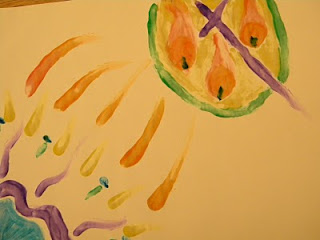
As a continued reflection on the Trinity I want to discuss Jürgen Moltmann’s idea of the Trinity as an event. This week I will post an open quote, and go from there next week. “In the cross, Father and Son are most deeply separated in forsakenness and at the same time are most inwardly one in their surrender. What proceeds from this event between Father and Son is the Spirit which justifies the godless, fills the forsaken with love and even brings the dead alive, since even the fact that they are dead cannot exclude them from this event of the cross; the death in God also includes them.” These are two packed sentences. I welcome any reflections, questions, thoughts and/or provocations, whatever. I look forward to walking with you as we reflect on the meaning of the Trinity in the event of the cross during Lent. Blessings. (Special note, the photo is a picture I took of my good friend Julie Scheibel practicing spiritual finger-painting)

10 days in Central America (pt. IV)

Image
(Typically this blog will update once a week with a reflection about the Trinity. Recently, however, I spent 10 days in Central America, and was unable to update. As such, this is the last entry in a series of four reflections of the trip.) Part IV. Evangelical Challenges: The most significant challenge I encountered was the reality of a globalized economy that favors some and creates overwhelming poverty for others. This is a challenge for a number of reasons. For one thing, poverty anywhere in the world undermines the basic proclamation that all of creation has its being in Christ (1 Cor. 8.6, A Social Statement on: Freed in Christ: Race, Ethnicity and Culture). A practical challenge global inequality creates is how sisters and brothers in Christ are to live together. Global inequality reinforces the historical discrimination that puts western and northern Europeans above all other ethnicities of the world. This historical discrimination is apparent in America’s Immig...

10 days in Central America (pt. III)

Image
(Typically this blog will update once a week with a reflection about the Trinity. Recently, however, I spent 10 days in Central America, and was unable to update. As such, this is the third entry in a series of four reflections of the trip.) Part III. Post Immersion Impressions: My post immersion impression really began to take shape about a week into the trip. By day four I noticed my journal entries had become more invested, longer, thoughtful and questioning. No longer did my entries just consist of what I had eaten, and seen. Slowly I began to describe how I was experiencing everything; how I felt, how I agreed, how I understood (or did not), how I thought this would impact me for the rest of my life. By day seven, then, I had wrestled with how and was beginning to look to being back in my context. I did know, however, that my context would be forever changed by this experience. So, as the immersion came to an end, and I find myself again in a privileged wealthy ...